
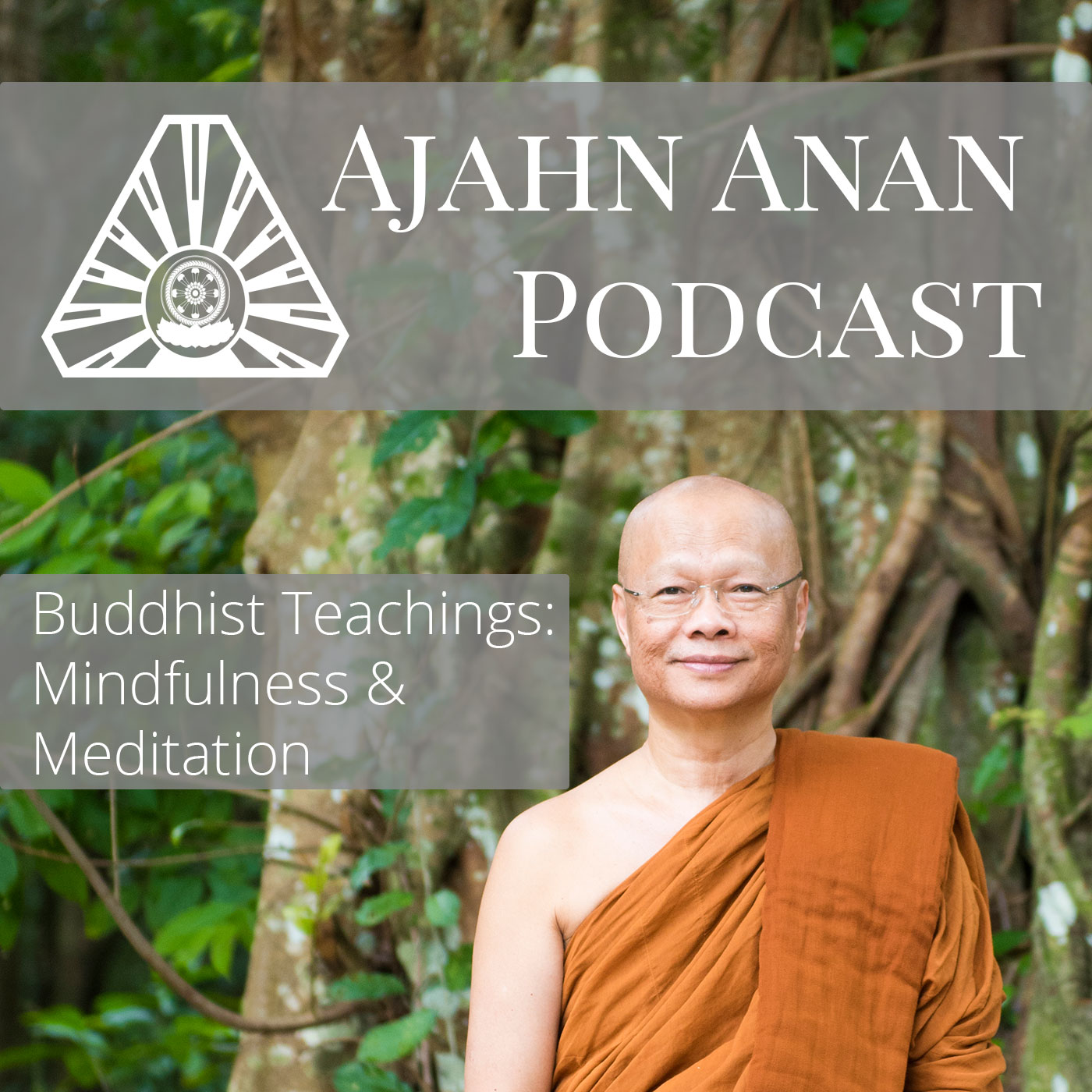
From this videoconference talk from 19 July 2019, Ajahn Anan discusses the Venerable Anya Kondanya, a great disciple of the Buddha, as well as advice for our own practice.
Two excerpts: “The Venerable arahant Anya Kodanya, what was it that he knew? The Buddha gave the sermon of a very ordinary nature. He taught that all things of the nature to arise have the nature to cease.
“He listened to the Dhamma just once and he succeeded to attain to becoming a sotapanna, a stream-enterer.”
Note: One can read talk transcripts at the Wat Marp Jan ‘Reflections’ page, which also includes questions and answers with Ajahn Anan, which are not in the audio files. See: https://watmarpjan.org/en/dhamma-reflections/reflections-archive/
A translation of a talk given by Ajahn Anan on February 8, 2020 on the evening of Magha Puja. In it, he discusses what the day symbolizes and how we can use it as a recollection to spur us forward in practice. The talk moves from the higher levels of Dhamma practice to the fundamentals of cultivating mindfulness.
From this videoconference talk from 5 July 2019, Ajahn Anan discusses the story of the blind men and the elephant.
Two excerpts: “In this world, there are more people who talk than people who take action. The people that like to criticise and ridicule others don’t have real knowledge about what they are saying. It can be compared to a bamboo tube that has no water. When it is hit, it makes a loud sound. And this is like the words of people who don’t know clearly according to truth. But they like to criticise and ridicule others according to their misunderstandings. They are like the “blind man feeling the elephant.” Let us look at the story behind this.
“There is no need to argue within the teachings of different traditions. Each of the traditions say they are right, but in reality it comes down to having mindfulness, having concentration, and beginning with the correct view of things.”
Note: One can read talk transcripts at the Wat Marp Jan ‘Reflections’ page, which also includes questions and answers with Ajahn Anan, which are not in the audio files. See: https://watmarpjan.org/en/dhamma-reflections/reflections-archive/
In this podcast, Ajahn Larry reads the Ratana Sutta in English.
The Ratana Sutta, or the Jewel Discourse, is a sutta that Ajahn Anan has recommended chanting particularly in the time of the Covid-19 pandemic. This sutta was taught by the Buddha as a way to help alleviate a plague afflicting the city of Vesali. When the monks chanted the sutta, the plague was dispelled and the city returned to prosperity.
One can listen peacefully or chant along in the Wat Marp Jan chanting book (pages 176-79): https://watmarpjan.org/en/audio-books/books/ (English translation included).
One can also see teachings in text form if one wishes: https://watmarpjan.org/en/dhamma-reflections/reflections-archive/
From this videoconference talk from 22 March 2019, Ajahn Anan discusses samadhi, or concentration, and its benefits.
An excerpt: “Concentration can help the mind to have radiance and become more subtle. It helps to reduce stress. It reduces anger and aggression. Concentration gathers the mind together and makes it strong. When the mind has the peace that comes from concentration, then there is also the quality of metta, or loving kindness, too.”
Note: One can read this talk and others at the Wat Marp Jan ‘Reflections’ page, which also includes questions and answers with Ajahn Anan, which are not in the audio files. See: https://watmarpjan.org/en/dhamma-reflections/reflections-archive/
From this videoconference talk from 6 March 2020, Ajahn Anan discusses the importance of patient forbearance and gentle composure, stories from the Buddhist texts, and the relevance to the current outbreak of a coronavirus, Covid-19, around the world.
An excerpt: “The other quality that makes one beautiful is soracca. This translates as being gentle and composed in body, speech and mind. One makes the mind radiant and joyous. The body is composed because when one has patiently endured, then one doesn’t show any abnormal, harmful gestures.”
Note: One can read this talk and others at the Wat Marp Jan ‘Reflections’ page, which also includes questions and answers with Ajahn Anan, which are not in the audio files. See: https://watmarpjan.org/en/dhamma-reflections/reflections-archive/
From this videoconference talk from 13 March 2020, Ajahn Anan discusses metta and giving, what our true refuge is, and the Covid-19 virus.
An excerpt: “May you take refuge in the Buddha, Dhamma, and Sangha as the highest refuge in our hearts, as our highest jewel and highest wealth. It is a noble wealth in our hearts. Each of us that has metta and self-sacrifice, then spread this heart of metta to ourselves and to all living beings, to all the people in the world. May all beings be free from dangers, and free from sickness.”
Note: One can read this talk and others at the Wat Marp Jan ‘Reflections’ page, which also includes questions and answers with Ajahn Anan, which are not in the audio files. See: https://watmarpjan.org/en/dhamma-reflections/reflections-archive/
From this videoconference talk from 21 February 2020, Ajahn Anan discusses the great Bhikkhuni Sigalamata Theri, foremost in faith out of the Bhikkhuni Sangha, and her son, Sigala.
Two excerpts: “The Buddha knew she was there and that she had a still mind, her faith was at a good level, and then the Buddha gave a talk about the foundations of faith. Sigalamata understood and attained to arahantship. The Buddha established her as being foremost out of all the bhikkhunis in gaining liberation through faith.
“If our faith drops, then think of arahant bhikkhuni Sigalamata, and this can raise our faith. Our faith grows bit by bit, like drops of water falling into an open vessel.”
Note: One can read this talk and others at the Wat Marp Jan ‘Reflections’ page, which also includes questions and answers with Ajahn Anan, which are not in the audio files. See: https://watmarpjan.org/en/dhamma-reflections/reflections-archive/
From this videoconference talk from 28 February 2020, Ajahn Anan discusses helping one another with sincerity, honesty, and generosity, especially in relation to the current outbreak of a coronavirus, Covid-19. A story of Bill Gates learning from a newspaper vendor is highlighted.
An excerpt: “The people who have received help are very grateful. In times of difficulties and crisis, if one still has friends that extend their kindness and compassion to each other, then our world will still be worth living in. We will live in a world where there are still people that give and where the receivers show appreciation. They become friends with each other. When different people cooperate like this, then they will be able to overcome obstacles and difficulties, like the spreading of the Covid-19 virus.”
Note: One can read this talk and others at the Wat Marp Jan ‘Reflections’ page, which also includes questions and answers with Ajahn Anan, which are not in the audio files. See: https://watmarpjan.org/en/dhamma-reflections/reflections-archive/
From this videoconference talk from 20 September 2019, Ajahn Anan discusses a story from the Buddha’s time, the story of Venerable Khema Theri, the Bhikkhuni foremost in wisdom.
Two excerpts: “And at that moment, the Buddha read Queen Khema’s mind and he made the beautiful maiden’s body gradually change little by little. From a young age to middle age, and gradually changing to old age. Then the Queen grew dispassion at seeing that when the beautiful maiden changed to being old, that her beauty disappeared.
“…Queen Khema, who had full spiritual development, attained to becoming an arahant with full mindfulness and wisdom, imbued with all the psychic powers, right at that time she was standing there.”
Note: One can read this talk and others at the Wat Marp Jan ‘Reflections’ page, which also includes questions and answers with Ajahn Anan, which are not in the audio files. See: https://watmarpjan.org/en/dhamma-reflections/reflections-archive/